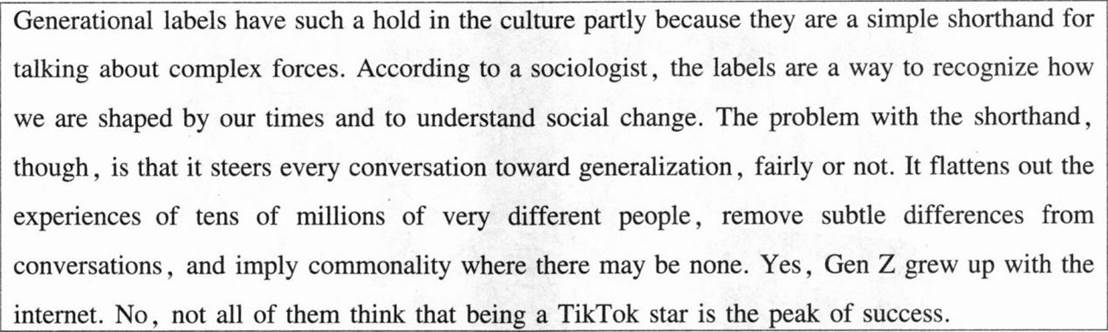
Read the following excerpt from an article and write an essay.In your essay, you should explain whether or to what extent you agree with the author.Support your argument with reasons and relevant examples.
Write your answer in 160-200 words on the ANSWER SHEET.(20 points)
参考答案
暂无
答案解析
(评论)
参考范文:
This excerpt examines a common social phenomenon: the use of generational labels such as post-90s,post-00s, Millennials and Generation Z. The author argues against using these labels to describe theseemingly shared characteristics of certain groups, saying that doing so will ignore individual differences andlead to sweeping generalizations. I'm in favor of this idea.
Admittedly, generational labels provide a shortcut to understanding the socio-economic background ofan age group. China's post-00s, for instance, are known to grow up amid the mobile interact boom, withtheir lives centered around smart devices. However, the indiscriminate use of such labels ends upreinforcing generational stereotypes, which may in turn obscure larger structural problems. As the post-OOsgeneration more and more frequently hits the headlines by fighting against a toxic work culture, someemployers jump to the conclusion that young people these days are far less industrious than priorgenerations, without considering whether their workforce management is outdated or how to improve theiremployees' motivation.
In summary, generational labels do more harm than good. This article serves as a timely reminder thatwhen someone is born matters less than generally thought, and that everyone should be treated more as anindividual than part of a group.
参考译文:
本选段探讨了一个常见的社会现象:90后、00后、千禧一代和z世代等代际标签的使用。作者反对使用这些标签来描述某些群体看似共有的特征,指出这样做会忽视个体差异并得出以偏概全的泛泛之论。我赞同这一观点。
诚然,代际标签能让人们快速了解某个年龄群体的社会经济背景。例如,众所周知,中国的00后是在移动互联网浪潮中成长起来的,他们的生活以智能设备为中心。然而,滥用此类标签最终会固化代际间的刻板印象,进而可能会掩盖更大的结构性问题。随着00后因反对有害的工作文化而越发频繁地登上头条新闻,一些雇主便贸然断定现在的年轻人远不如前几代人勤奋,而不去考虑其劳动力管理方式是否过时或者如何提高员工的积极性。
总之,代际标签弊大于利。本文适时地提醒人们,一个人的出生时间并没有通常所认为的那么重要,每个人都更应该被当作独立的个体而非群体的一部分来对待。
你可能感兴趣的试题
A.borne out
B.ruled out
C.offered up
D.carried on