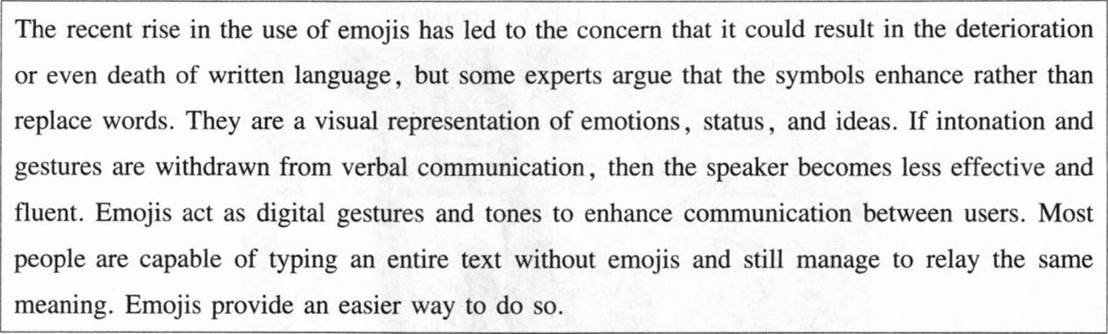
Read the following excerpt from an article and write an essay.In your essay, you should explain whether or to what extent you agree with the author.Support your argument with reasons and relevant examples.
Write your answer in 160-200 words on the ANSWER SHEET.(20 points)
参考答案
暂无
答案解析
(评论)
参考范文:
There is growing concern that the popularity of emojis is undermining our communication ability andeven ruining written language. On the contrary, some experts tend to resist this gloom, stating that emojisare actually conducive to language use. I am in favor of the latter.
In all fairness, emojis provide a good supplement to language, not a substitute for it. Functioning asthe body language that appears along with speech, emojis serve to fill in the emotional cues otherwisemissing from written texts. In this way, they help reduce the chance of misinterpretation or ambiguity.Additionally, these little symbols can add a fun and personal touch to the dry messages, thereby easingembarrassment and facilitating communication. On top of that, as the saying goes, "A picture is worth athousand words." Emojis allow us to express more thoughts in a limited space, which goes a long waytowards increasing communication efficiency.
In this increasingly digital world, emojis have become an inextricable part of online interaction. Butthat doesn't mean it is reasonable to overuse them. Instead, we should bear in mind that emojis are merely acomplementary tool which must be utilized properly and moderately.
参考译文:
越来越多人担忧表情符号的普及正在削弱我们的表达能力,甚至会毁掉书面语言。相反,一些专家倾向于反对这一消沉想法,称表情符号实则对语言使用有益。我赞同后者的观点。
客观公正地说.表情符号是对语言的良好补充物,而非替代品。和口头交流中出现的肢体语言功能一样,表情符号有助于填补书面文字中未表达出来的情感线索。这样可以减少误解或歧义的可能性。其次,这些小小的符号还能给于瘪的文字增添一抹趣味与个性,从而缓解尴尬、促进交流。此外,有言道,“一张图胜过千言万语”。表情符号使我们能够在有限的空间内传达更多思想,这对于提升交流效率大有裨益。
在这个日益数字化的世界,表情符号已成为在线交流中不可分割的一部分。但这并不意味着我们有理由对其滥用。相反,我们应谨记表情符号只是一种辅助工具,必须合理、适度地使用。
你可能感兴趣的试题
A.confirms
B.warns
C.denies
D.promises