简答题
题号 #6559921

Directions:
  Write an essay based on the picture below.In your essay, you should
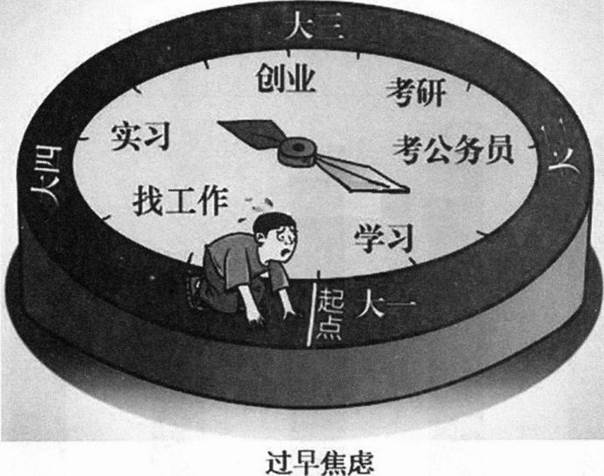
     1 ) describe and interpret the picture, and
     2) give your comments.
  Write your answer in about 150 words on the ANSWER SHEET.( 15 points)
进入在线模考

参考答案

暂无

答案解析

参考范文:
 The picture features a student in a panic about his upcoming college life. He is overwhelmed by thethought of having to take classes and also study for the postgraduate entrance exam or the civil service examin the following four years, while setting aside time for working as an intern, seeking a job or starting abusiness. As the caption below the picture suggests, he feels anxious much earlier than necessary.
 It is understandable that some would-be college students worry about competition from their peers.However, excessive anxiety will not bring them real benefits such as a dream job. On the contrary, it willundermine their determination to meet tough challenges. Additionally, college life is not only aboutpreparing for exams and the job market, but more importantly, about exploring a wide variety of possibilitiesfor personal growth and development.
All in all, there is no point in being anxious about the future, which is unpredictable and uncontrollable.Instead, it is advisable to focus on the present and learn to embrace uncertainty.
参考译文:
图片的主角是一名对即将到来的大学生活感到慌乱的学生。他一想到自己在接下来的四年里既要上课,又要复习备考研究生或公务员,同时还要留出时间实习、找工作或创业,就不知所措。正如图片下方的文字所示,他过早地感到了焦虑。
一些准大学生为来自同龄人的竞争感到担忧,这可以理解。然而,过度焦虑不会给他们带来诸如梦寐以求的工作等实际益处。它反而会削弱其迎接艰巨挑战的决心。此外,大学生活不仅关乎为考试和求职做准备.更重要的是关乎探索个人成长与发展的各种可能性。
总而言之.对未来感到焦虑是没有意义的,因为未来不可预知、不可控制。相反,可取的做法是专注于当下并学会接受不确定性。

你可能感兴趣的试题

1 根据以下材料,回答题
How do early experiences shape development? A new paper by Dr.Mackey and hercolleagues looks at evidence from both human and animal studies.They 1 that poverty, stressand adverse experiences seem to make children's brains grow up too quickly.
   Why would stress and adversity make us grow up faster and a rich, varied, nurturingenvironment make us grow up more slowly? One influential recent idea 2 from the biologicalconcept of "life history." A long, slow life history 3 with a big, smart brain.The smartestmammals and birds, like chimps and crows, also have a particularly long childhood, and adults puta lot of work into 4 the young.We humans are particularly 5 , with an especially longchildhood and large caregiving 6   .
  Different species have different life histories, but different individual animals also maydevelop different life histories.Some will 7 more quickly, while others stay young for longer.Early experiences can 8 these individual life histories. 9 , what happens when you'reyoung tells you about the sort of world you will face when you get older.
   A "live fast, die young" life history makes more evolutionary 10 when resources arescarce and life is 11 harsh. 12 learning may not do much good in that case, so it's betterfor young creatures to quickly zero in on a few effective survival techniques.In a rich, supportive,varied world, 13 , there is 14 to learn and time and resources to learn it, so keeping anopen mind and flexible brain is more 15 .Early adverse experiences may be cues that the life tocome will be harsh and short, while a nurturing preschool 16 a richer set of possibilities.
   Loving your children and giving them space to 17 is more important than crafting aparticular curriculum.A longer, slower childhood may be better, at least if you 18 that theadult environment will also be rich and varied.But as the research on adverse experiences shows,far too many children and parents don't have the resources they need to 19 that sort ofchildhood.Whether through child tax credits, parental leave or high-quality preschool, supportingyoung children is the best way to ensure a new generation of 20 adults.
第1题答案是(  )
A.defend
A.defend
B.conclude
B.conclude
C.deny
C.deny
D.doubt
D.doubt
A.takes off
A.takes off
B.breaks away
B.breaks away
C.takes over
C.takes over
D.stands out
D.stands out
A.starts
A.starts
B.ends
B.ends
C.goes
C.goes
D.changes
D.changes
找试题 · 找答案 · 找资料 在线模考