简答题
高中英语
题号 #6601654
设计任务:根据下面的学生信息和语言素材,设计20分钟的阅读教学方案。教案没有固定格式,但须包含下列要点:
·teaching objectives
·teaching contents
·key and difficult points
·major steps and time allocation
·activities and justifications
教学时间:20分钟
学生概况:某城镇普通中学高中一年级学生,班级人数40人。多数学生已经达到《义务教育英语课程标准(201 1年版)》五级水平。学生课堂参与积极性一般。
语言素材:
If you say the word "communication" , most people think of words and sentences. Althoughthese are very important, we communicate with more than just spoken and written words. Indeed,body positions are part of what we call "body language" . We see examples of unconscious bodylanguage very often, yet there is also "learned" body language, which varies from culture to culture.
We use "learned" body language when we are introduced to strangers. Like other animals, weare on guard until we know it is safe to relax. So every culture has developed a formal way to greetstrangers, to show them we are not aggressive. Traditionally, Europeans and Americans shake hands.They do this with the right hand--the strongest hand for most people. If our right hand is busygreeting someone, it cannot be holding a weapon. So the gesture is saying, "I trust you. Look, I'mnot carrying a threatening weapon." If you shake hands with someone, you show you trust them. Weshake hands when we make a deal. It means, "We agree and we trust each other."
Greetings in Asian countries do not involve touching the other person, but they always involvethe hands. Traditionally in China, when we greet someone, we put the right hand over the left andbow slightly. Muslims give a "salaam" , where they touch their heart, mouth and forehead. Hindusjoin their hands and bow their heads in respect. In all of these examples, the hands are busy with thegreeting and cannot hold a weapon.
Even today, when some people have very informal styles of greeting, they still use their handsas a gesture of trust. American youths often greet each other with the expression, "Give me five!"One person then holds up his hand, palm outwards and five fingers spread. The other person raiseshis hand and slaps the other's open hand above the head in a "high five" . Nowadays, it is quite acommon greeting.
Body language is fascinating for anyone to study. People give away much more by theirgestures than by their words. Look at your friends and family and see if you are a mind reader!
注:语言素材选自外研版必修4 Module 3 Body Language and Non —verbal Communication第22页。
参考答案
暂无
答案解析
Teaching Contents:
In this reading class, students will learn a passage about some greetings around the world.
Teaching Objectives:
(1) All the students will master some new words such as "gesture, position, weapon, deal, trust, formal,
informal, aggressive, unconscious" after learning this passage.
(2) After reading the article, students will know about some greetings around the world and can retell the passage.
(3) Students can use proper greetings to communicate with others.
(4) Students can understand the importance of body language and learn to use appropriate body language to express emotions.
Teaching Key and Difficult Points:
(1) Teaching key point
Students can understand the passage and master the new words.
(2) Teaching difficult point
Students can know how to communicate with others by using appropriate body language.
Major Steps:
Step 1 Pre-reading (4 minutes)
(1) Show some pictures of different gestures on the PPT and teach the new words by talking about the pictures and explaining the meaning.
(2) Ask students to predict what the passage is about according to the given pictures.
(Justification: This step can help students master the new words and raise their interest in the article.)
Step 2 While-reading (9 minutes)
(1) Fast reading
Activity 1 Skimming
Ask students to read the article quickly and choose the best title. Then divide them into pairs to explain why they choose the title to their partner.
□Saying It without Words
□When in Rome, Do as the Romans Do
□Greetings Around the World
□Read My Mind
Activity 2 Scanning
Ask students to read the article carefully and complete the table below
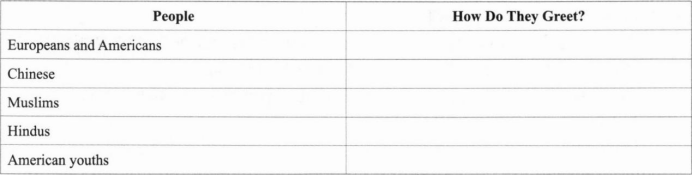
(2) Careful reading
Ask students to read the article again and decide these statements true (T) or false (F). They need to find
evidence from the passage to support their views.
①Not all body language is conscious.( )
②Europeans shake hands with their left hand. ( )
③In Asia, people touch strangers when they meet.( )
④In the US, a "high five" is a way of saying hello. ( )
⑤A "high five" is a formal gesture. ( )
⑥Body language is less communicative than spoken or written language. ( )
(Justification: Through these activities, students will get the main idea of the passage and know about some greetings around the world, and their reading skills can be improved.)
Step 3 Post-reading (7 minutes)
(1) Retelling
Invite several students to retell the passage with the help of the table above.
(2) Discussion
Divide students into groups of four to talk about how they greet their family members, friends and strangers and why they do that.
(Justification: Retelling can help students consolidate what they have learned in this class. The discussion can help students learn the proper ways of greeting to communicate with others.)
In this reading class, students will learn a passage about some greetings around the world.
Teaching Objectives:
(1) All the students will master some new words such as "gesture, position, weapon, deal, trust, formal,
informal, aggressive, unconscious" after learning this passage.
(2) After reading the article, students will know about some greetings around the world and can retell the passage.
(3) Students can use proper greetings to communicate with others.
(4) Students can understand the importance of body language and learn to use appropriate body language to express emotions.
Teaching Key and Difficult Points:
(1) Teaching key point
Students can understand the passage and master the new words.
(2) Teaching difficult point
Students can know how to communicate with others by using appropriate body language.
Major Steps:
Step 1 Pre-reading (4 minutes)
(1) Show some pictures of different gestures on the PPT and teach the new words by talking about the pictures and explaining the meaning.
(2) Ask students to predict what the passage is about according to the given pictures.
(Justification: This step can help students master the new words and raise their interest in the article.)
Step 2 While-reading (9 minutes)
(1) Fast reading
Activity 1 Skimming
Ask students to read the article quickly and choose the best title. Then divide them into pairs to explain why they choose the title to their partner.
□Saying It without Words
□When in Rome, Do as the Romans Do
□Greetings Around the World
□Read My Mind
Activity 2 Scanning
Ask students to read the article carefully and complete the table below
(2) Careful reading
Ask students to read the article again and decide these statements true (T) or false (F). They need to find
evidence from the passage to support their views.
①Not all body language is conscious.( )
②Europeans shake hands with their left hand. ( )
③In Asia, people touch strangers when they meet.( )
④In the US, a "high five" is a way of saying hello. ( )
⑤A "high five" is a formal gesture. ( )
⑥Body language is less communicative than spoken or written language. ( )
(Justification: Through these activities, students will get the main idea of the passage and know about some greetings around the world, and their reading skills can be improved.)
Step 3 Post-reading (7 minutes)
(1) Retelling
Invite several students to retell the passage with the help of the table above.
(2) Discussion
Divide students into groups of four to talk about how they greet their family members, friends and strangers and why they do that.
(Justification: Retelling can help students consolidate what they have learned in this class. The discussion can help students learn the proper ways of greeting to communicate with others.)
你可能感兴趣的试题
A.Susan of me
B.Susan took
C.Susan took of me
D.Susan took a picture
A.That male lions help
B.Male lions which help
C.Although male lions help
D.It is male lions that help