简答题
小学英语
题号 #6645971
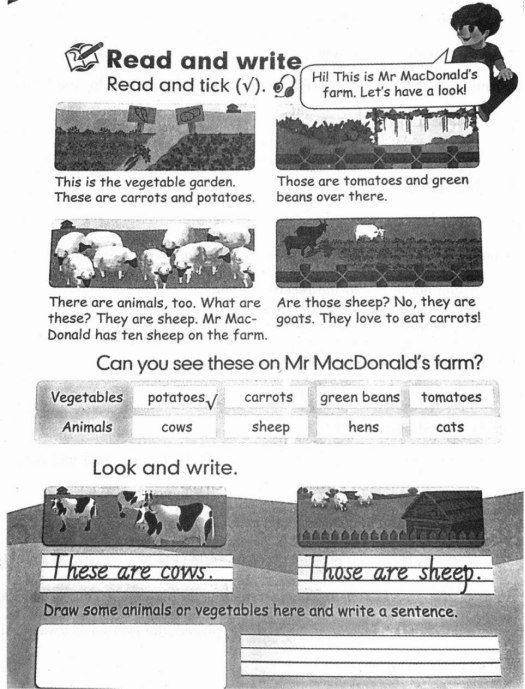
根据下面提供的教学材料,设计一个读写课的教案,请分析文本,确立教学目标,设计教学活动,并在恰当之处辅以设计意图说明,中英文皆可。
参考答案
暂无
答案解析
Context Analysis:
(1)This unit is the fourth unit in Volume 2 0f Grade 4.The theme of study is to visit the farm.Taking Mike,Sarah,Chen Jie’s visit to the farm is the main line,presenting the vocabulary and sentence patterns to be learned in this unit.In the previous lessons, students have learned vocabulary about vegetables and farm animals,and learned the main sentence structures:What are these/those—They are…Are these/those…?Yes,they are./N0,they aren’t. These are...Students should learn the content of this lesson on this basis.
(2)The teaching content of this lesson is divided into two parts:reading and writing.
Teaching objectives:
Knowledge objective
Students can complete the reading and writing tasks in the read and write section,and practice vocabulary and sentence patterns about the farm.
Ability objectives
①Students can use“These are…/Those are…”to describe animals and plants. ②Students can use“These are…/Those are…’’to look at the pictures and write sentences.
③Through various activities,students’listening, speaking and reading abilities are further improved.
Emotion objective
Through a variety of activities,students can learn to cooperate with others and form a good habit of eating more vegetables.
Key and difficult points:
④Key point:
Master the application of two key sentences:
“These/Those are…”.
②Difficult point:
Apply“These/Those are…”correctly in the different situations.
Step l Warm-up
Greetings.
Play let’s chant and let all students clap and sing together.
The teacher asks one question:How many kinds of vegetables are mentioned in the chant?What are they?
(设计意图:让学生跟唱本课时的歌曲,激发学生学习的兴趣。歌曲活跃了课堂气氛,简单的问候拉近了师生间的距离。)
Step 2 Pre—reading
The teacher guides the students to observe the pictures and answer the question:What’s on Mr MacDonald’s farm?
After that,the teacher points the pictures and reviews the structures:There are some…/What are those?
(设计意图:复习动物和蔬菜的单词和句型,激发学生相关的知识储备,为本节课的综合运用语言做好铺垫。)
Step 3 While—reading
The teacher lets students listen to the first part of read and tick,and answer the questions.After thatthe teacher guides the students to use scanning to quickly complete the exercises OH the screen.
Then the teacher explains the new word“garden”,summarizes the composition of“farm”.and invites different students to read the first and second paragraphs respectively.
The teacher lets students listen to the second part of read and tick and answer the questions.Then the teacher explains the differences between goat,sheet and lamb,guides students to use scanning to quickly complete the exercises on the screen,and asks students to read the third and fourth paragraphs respectively.
(设计意图:学生听并朗读课文,理解短文大意,关注文段的细节,在文中找到问题的答案,培养学生迅速找出文章相关信息的能力,掌握阅读策略。)
Step 4 Post-reading
Lead students to do exercises ,inclding wriling,listening and picture matching. (设计意图:让学生利用自己已有的知识储备进 行学习,体现先学后教。)
Step 5 Conclusion
The teacher asks a student to retell what he/she has learned in this class. Step 6 Homework
(1)Introduce farm to parents in English.
(2)Complete pages 33 and 34 0f the workbook.
(设计意图:学生通过向父母描述farm,向父母展示自己的学习成果,提升学习英语的成就感。练习册里的习题可以帮助学生在课后更好地巩固所学知识。)
评分标准:本题共20分。(1)分析文本时,主要对课程主题、主要内容、学生的学情进行分析,并点明教学内容分为“读”和“写”两部分,共2分。(2)教学目标具体对应本课内容,三维目标各1分,共3分。若与教学内容及学生学情不符,则酌情扣1~2分。(3)教学重点和教学难点各1分。教学重点应体现教学的重要内容,教学难点体现学生较难理解的知识与方法,两者应尽量有所区别。(4)教学步骤包括“热身环节”“读前环节”“读后环节”“课堂总结”及“作业布置”部分。其中,①热身环节设计可以从问题导入,也可以采用直观导入法(如歌曲导入)、背景知识导入法等,导入简洁、有针对性、有趣味性可得1分;②读前环节利用情境、直观教具或电教手段呈现新的语言知识可得2分;③读中环节是阅读中最重要的环节,引导学生获取短文信息,掌握阅读策略,体现学生的主体地位和教师的主导作用可得5分,没有体现可酌情减1~1.5分;④读后环节引导学生对新知进行巩固和运用,活动设计有目的性、全面性和参与性可得1分;⑤有课后总结、作业布置各得1分。作业布置应有层次性。⑥主要教学环节(热身、读前、读中、读后)有设计意图可得2分,没有酌情扣0.5~1分。共13分。
你可能感兴趣的试题
A.Don't mention it.
B.I hope so.
C.No problem.
D.It's all right.
A.minds
B.matters
C.cares
D.considers
A.put aside
B.pick out
C.deal with
D.run into