A.Education and national security.
B.A new report by the Council on Foreign Relations.
C.The impact of poor education.
D.Social cohesion and American dream.
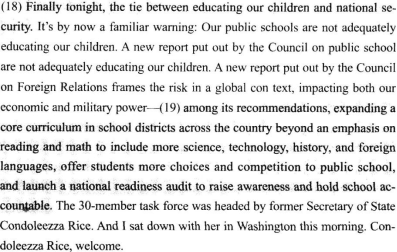
(R): Thank you.
(I):
Secretary Rice, why frame this as a national security issue? And make it con- crete. What's the specific impact you see of poor education?
(R):
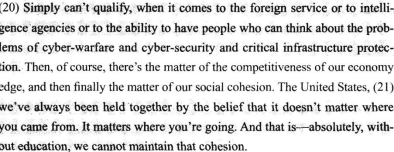
National security is broader than what you can do with you military forces, ob- viously. But, even there, when it comes to the very tangible assets that United States needs to defend itself, the education of people who can be soldiers, too many people can't quality for military service.
(I): Simple can't qualify?
(R):
你可能喜欢
A.To make reading and math the most emphasized subjects.
B.To inclined more courses, such as technology and foreign languages.
C.To offer teachers more choices.
D.To establish more private schools for students.
A.The belief that they have the most competitive economy.
B.The belief that they are the most powerful country in military forces.
C.The belief that they can achieve anything so long as they work hard.
D.The belief that public life is unfair.
A.The belief that they have the most competitive economy.
B.The belief that they are the most powerful country in military forces.
C.The belief that they can achieve anything so long as they work hard.
D.The belief that public life in unfair.