单选题
题号 #6054718

The author's attitude toward Senate Bill 98 can be described as

进入在线模考

参考答案

C

答案解析

作者对州参议院第98号法案的态度可以说是。
[A]支持的[B]容忍的[C]失望的[D]含混的
[信息锁定]第五段②③句介绍州参议院第98号法案的具体内容“限制学生的人均助学金额度”及目的“限制特许学校招生规模”,④句指出该法案的后果“令低收入家庭学生(难以进入特许学校,从而)沦为受害者”,由此可知,作者对该法案持负面态度,C正确,同时排除完全相反的A。
[解题技巧]B的内涵为“承认法案的负面影响但包容它”,但由作者对法案影响的描述“低收入家庭学生沦为受害者”及前文作者站位“支持填补教育鸿沟”可知,作者无法容忍限制学生加入特许学校的法案。D错将末段首句的疑问语气理解为作者对法案持含混态度,但该句意在强调“反思择校相关政策”的重要性,且上段已明确指出“低收入家庭学生最终遭殃”,因此作者对法案的态度是明确否定。
全文翻译
改革美由教育体制的怨声持续多年以后,新冠肺炎疫情正成为推动体制改良的催化剂。美国的教育鸿沟如今已是有目共睹。教育质量与可及性的悬殊对经济、社会和种族不平等现象推波助澜,进而导致如此多的社会动荡。而无论是来自市区的贫困社区还是郊区,低学历的美国人遭到的疫情及其经济冲击都最为严重。
幸运的是,经济学家托马斯·索厄尔提供了一个解决办法。他在新作《特许学校及其死敌》一书中指出,比公立学校有着更多自主权和灵活性的学校正在填补教育鸿沟,提供急需的选择、机遇和竞争。
索厄尔对取自疫情爆发之前的数据的细致分析表明,政府出资而私人运营的特许学校的学生在标准化学业考试中取得的成绩远比传统公立学校的学生优秀。然而特许学校的批评者会列出很多理由,索厄尔哀叹说,但最主要的原因是公立学校根本就不想要这种竞争。
新冠肺炎危机是否终将改变这一切?已有正面迹象表明情况已开始改变。上月,美国教育部部长贝齐·德沃斯新推出了一项为期五年、金额达8500万美元的奖学金专款,用以帮助华盛顿特区的低收入家庭学生择校入学。另一个利好标志则是参议员蒂姆·斯科特和拉马尔·亚历山大最近提交的一项法案,该法案将动用部分教育援助专款并投入择校项目。这笔资金可帮助因疫情陷入困境的低收人家庭,让他们能够送孩子去可选的学校(非公立学校)上学。
但更能说明问题的可能是许多家庭和个人自行想出了解决办法。想想疫情期间突然涌现的“学习舱”吧,社区内部的家长组织起来、找到老师、为孩子开班。当然,学习舱已经有了自己的反对者:批评者要么抱怨这种做法对传统学校不公平且有害,要么说它只适用于请得起老师的家庭。但这更加表明,让有效实施高质量教育的学校更加普及有多么重要。掐掉新想法并不是办法。
围绕疫情时期教育的斗争已迅速蔓延至州议会。六月,加利福尼亚州议会通过了州参议院第98号法案(该州新预算的组成部分),该法案将该州特许学校和公立学校学生的人均助学金限额设置为去年的资助水平。法案目的是限制特许学校招生规模,因为对传统公立学校之外的学校需求正在迅速增长。然而,随着传统公立学校停学并转向远程授课,来自低收入家庭的学生将沦为最终的受害者。
这将如何影响对孩子的教育?只有当我们明确地专注于这个问题,疫情对教育的长期影响才能是相当有益的。

你可能感兴趣的试题
1 根据下面资料,回答题
Today, telehealth has revived the house call more than a century after it fell out of favor.
This renewal of a bygone practice is less intimate than having a doctor sitting at your bedside, but more personal than sitting on your doctor's exam table. It allows doctors to once again observe daily details of their patients' health that they might not otherwise glimpse.
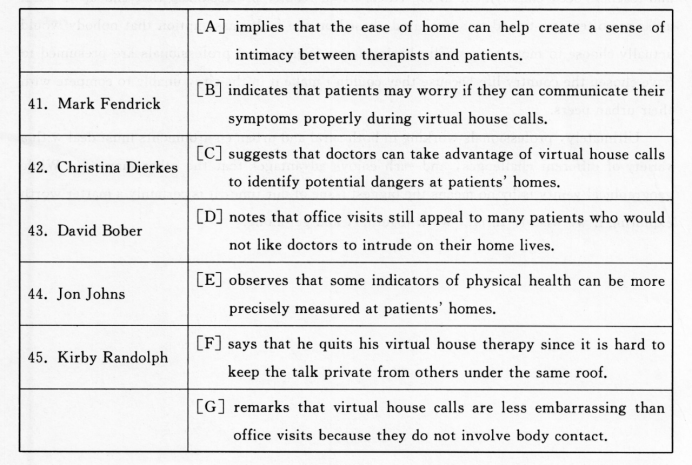
"The doctor's office is a stressful place for everyone," Mark Fendrick, a primary-care doctor with Michigan Medicine, said.  "There are some things we look for that are more artificial in a doctor's office and more rea[world at home. " Studies have shown, for example, that automated blood-pressure measurements taken when a patient is sitting alone in a quiet place are more accurate.  People with white-coat hypertension regularly experience higher blood pressure in clinical settings as a result of anxiety or fear. At-home tests, Fendrick said, can better capture a person's usual blood pressure.
A virtual house call can also improve the quality of treatments. Christina Dierkes, a 37-year-old from Columbus, Ohio, usually dreads the end of an intense therapy session. "You bare your soul to this person," she said, "and then you're running into somebody in the elevator and sitting in the car crying and driving home. " Since March, she's connected with her [therapist over the phone. "I was at home, in my own space, in sweatpants. It made it easier to imagine I was talking to myself or someone I feel really safe with," she said.
i This advantage is, to some degree, subjective. David Bober, a 51-year-old in Maryland,  struggles to find a quiet spot at home where he won't be overheard or interrupted during psythiatry sessions and is ready to return to in-person therapy. And having to verbalize bodily  concerns to a doctor who can't touch or examine a patient up close can be a source of  discomfort. Jon Johns, a 54-year-old in eastern Ohio, had his annual physical over video conference in April. "But what if I was in pain or something was wrong.9" he says. "I would be anxious about how well I was describing my symptoms. "
Whatever might  be  missing  from  the  patient's  descriptions,  doctors  can  collect information through telemedicine that they wouldn't otherwise have access to. And this might be the true magic of the virtual house call.  For example, over video, Carman Ciervo, a primary care physician for Jefferson Health in Philadelphia, monitors the video's background for railings or potential tripping hazards if a patient has mobility issues. "Just observing how they climb the stairs can give you a wealth of information," Ciervo says. "These are all safety problems they might not be aware of, and that might not come up in an office visit. "
However, as the Kansas City University medical historian Kirby Randolph points out,
keeping one's personal life private might be the point of going into a generic doctor's office.
"A lot of patients don't want the doctor to see their home environment, because they're sell conscious," she said.  Domesticating medicine's turf won't cure the biases baked into its history that could color how a clinician interprets a patient's surroundings.
"The very deep social determinants of health and illness seem so unmanageable that
finding a technological solution that might short-circuit them is enormously appealing. " said Jeremy Greene, a Johns Hopkins medical historian. The virtual house call challenges the notion that medicine exists only in clinical settings, and offers doctors a view into the space where a person's health exists as a lived experience.
 
第(41)题选
A. 
A.A
B. 
B.B
C. 
C.C
D. 
D.D
E. 
E.E
F. 
F.F
G. 
G.G
A. 
A.A
B. 
B.B
C. 
C.C
D. 
D.D
E. 
E.E
F. 
F.F
G. 
G.G
A. 
A.A
B. 
B.B
C. 
C.C
D. 
D.D
E. 
E.E
F. 
F.F
G. 
G.G
找试题 · 找答案 · 找资料 在线模考