单选题
题号 #6055818

What will happen if farms can not grow the same amount of bananas as before?

进入在线模考

参考答案

C

答案解析

细节题。第三段中提到,未来几年香蕉的产量可能比不上以前,主要会造成两个方面的影响.一是香蕉是许多人的主食,香蕉数量减少会影响粮食安全,二是香蕉为部分热带和亚热带地区的种植者提供收入,香蕉本身利润就低,产量再减少的话会影响到农民的收入。因此答案应该选[C]“粮食安全在一些国家很难得到保障”。[A]“农民将不得不提高售价”,[B]“未来香蕉在全球范围内会更便宜”,[D]“香蕉生产商将被迫转向其他行业”,文中都没有提到。

你可能感兴趣的试题

A.It mainly affects places with drier soil conditions.
B.There is no effective way to handle the disease properly.
C.The disease is highly infectious and easily transmitted.
D.Farmers have to make huge invests on maintaining bananas.
A.Climate change impacts on banana yields around the world.
B.Humans need to limit the temperature increase during the 21st century.
C.Technologies can help us to have a sustainable source of bananas.
D.Banana growers can invest in sustainable production and research.
3 根据以下材料,回答题
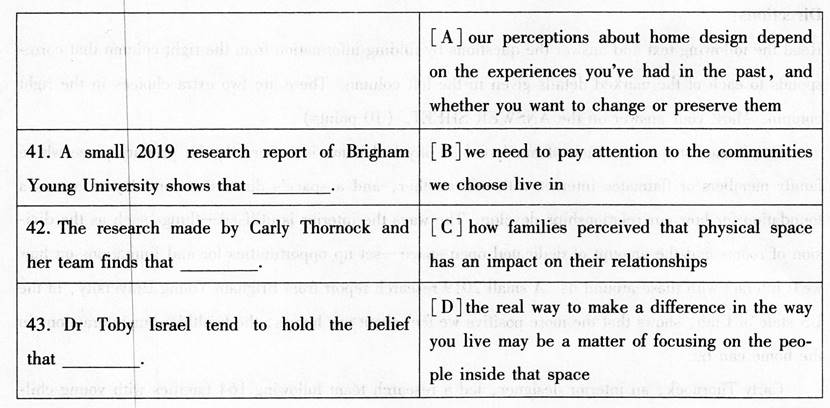
Our homes shapes so much of our lives.A physical home is, after all, the primary place where family members or flatmates interact with one another, and a space's dimensions and layout act as a foundation for how our relationships develop.The ways the interior is utilised things such as the division of rooms and the amount of dedicated open space--set up opportunities for and limitations on how we'll interact with those around us.A small 2019 research report from Brigham Young University, in the US state of Utah, shows that the more positive we feel about our homes, the healthier our interactions in the home can be.
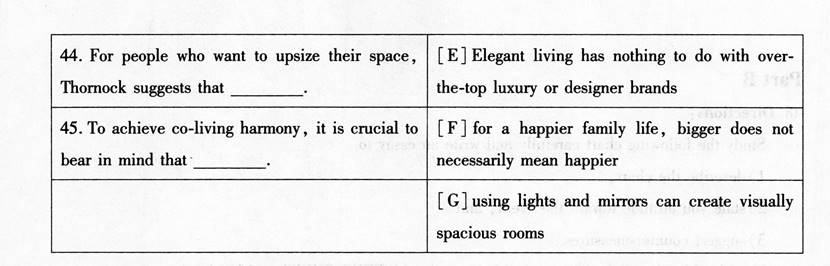
Carly Thornock, an interior designer, led a research team following 164 families with young children in the western US who came from a wide spectrum of home types and income levels.Overtwo years, they observed how their physical environments related to four basic elements of family functio In, acceptance and decision making.The researchers found overall that increases in physical space per person did not correspond to happier families.Perhaps surprisingly, the amount of actual space a home has isn't as important as how the members of the home plan for and use the areas.
Dr Toby Israel, design psychologist and author of Some Place Like Home : Using Design Psychology to Create Ideal Places, believes that every person has a distinctive"environmental autobiography"--our own personal history of place.Although often subconscious, our associations and sensations with physical places are reworked, replicated or rejected throughout our lifetime, she says.Comparing our current
spaces to the homes we grew up in can be a fun and insightful way to learn about our own personal histories of place, Israel says."Very often, people will choose homes with a very similar layout to the homes that they've had in childhood.And sometimes they do something totally different."
It's likely financially prohibitive or just too challenging to simply up size your space because you
want to.But changing our homes for the better is always within reach."As cities grow that rapidly and
there just isn't enough space, you have to get creative on the mindset part because, really, your circumstances might not be changeable," says Thornock.Even if you're in the same physical place, she says, "there's always a way to make even the tiniest space work for you".For instance, Thornock says that if perceived crowding is the issue, you can start by opening the space with lights and mirrors.
Actively lmaking changes in the name of a healthier home means considering both physical space itself as well as how people communicate within it.Whether it's a shared apartment with flatmates, or a full family home, designing our spaces with others in mind is key for reaching co-living harmony.


第41题答案是
A.A
B.B
C.C
D.D
E.E
F.F
G.G
找试题 · 找答案 · 找资料 在线模考