单选题
题号 #6057087

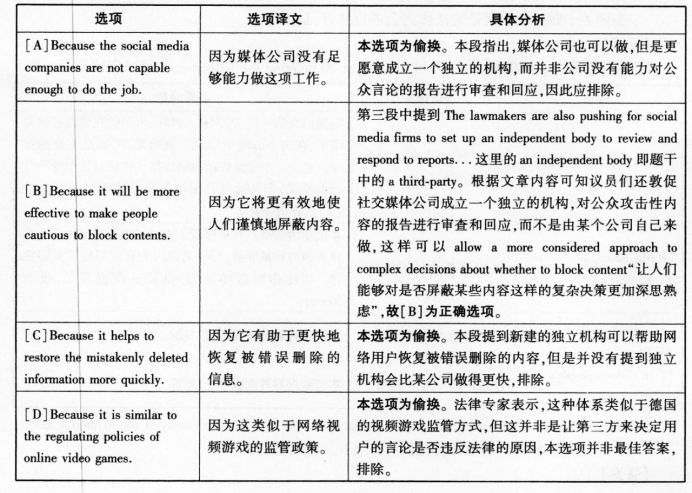
Why did lawmakers insist on a third-party to determine whether users' speech violates the law?

进入在线模考

参考答案

B

答案解析

Why did lawmakers insist on a third—party to determine whether users’speech violates the law?
为什么立法者坚持让第三方来决定用户的言论是否违反了法律?
细节题。根据题干关键词a third.party可对应到文中第三段。
 

你可能感兴趣的试题

A.caused the criticism from opponents of the legislations and German journalists
B.stimulated the opposition of free speech campaigners and German journalists
C.originated from the threat of hefty fines negatively influencing internet firms
D.I came from the blocked content on a satirical magazine's Twitter account
A.It's urgent for all the countries in the world to block hate speech.
B.Many countries are considering blocking illegal internet contents.
C.Many countries have taken measures to resist negative online contents.
D.Different countries are confronting with different online problems.
3 根据下面资料,回答题
What is the price of anarchy?
Technically, in transportation engineering, the price of anarchy describes the difference betweenwhat happens when every driver selfishly picks the fastest route and what the socially optimal trafficoutcome would be. In the pre-mobile-app days, drivers' selfishness was limited by their knowledge of theroad network. In those conditions, both simulation and real-world experience showed that most people
stuck to the freeways and arterial roads. Sure, there were always people who knew the crazy, back-roadroute, but the bulk of people just stuck to the routes that transportation planners had designated as thepreferred way to get from A to B.
But a new body of research at the University of California's Institute of Transportation Studiessuggests that the reality is far more complicated. In some scenarios, traffic-beating apps might work foran individual, but make congestion worse overall. And autonomous vehicles, touted as an answer totrafficy streets, could deepen the problem.
"This problem has been vastly overlooked," Alexandre Bayen, the director of UC Berkeley'sInstitute of Transportation Studies, told me. "It is just the beginning of something that is gonna be muchworse. " "The situation then gets much worse because hundreds of people just like you want to go on theside streets, which were never designed to handle the traffic," Bayen says. "So, now, in addition tocongesting the freeway, you've also congested the side streets and the intersections. "
While it's clear that these apps can put stress on local side streets, we still don't know what effectthey may have on highways, or for traffic systems as a whole. "This is an open problem," said Bayen.
"Hence, we need to be very cautious in our conclusions. "
They're building on pioneering work by researchers like Hani Mahmassani into the role of real-timeinformation in shaping traffic conditions. In 1991, Mahmassani challenged what he took to be "possiblemisconceptions that information will automatically lead to improvements in traffic conditions. " He wasnot alone. That same year, other researchers noted that "information can cause drivers to change theirdeparture times in such a way as to exacerbate congestion. "
Nonetheless, most of this early work showed that when the percentage of drivers with access toinformation was low, there was a major benefit for better-informed drivers.So, in the early days ofWaze and Google Maps and automated routing at UPS, many individuals did experience substantialbenefits from these applications. The roads, as a whole, were probably also flowing better.
Bayen does, in fact, have a suggestion for improving these apps, but the companies might not likeit. He thinks the apps should spread out drivers on different routes intentionally, which would requirecollaboration among the mapping apps. Given the cutthroat nature of competition in Silicon Valley,that's a tough sell, but it might help bring down the price of anarchy.
What may fundamentally lead to the anarchy in transportation.'?
A.All drivers drive under the guidance of the mobile apps.
B.All drivers choose their fastest and most convenient ways.
C.All drivers pick the freeways and arterial roads.
D.All drivers drive along the back road and country roads.
找试题 · 找答案 · 找资料 在线模考