单选题
题号 #6057140

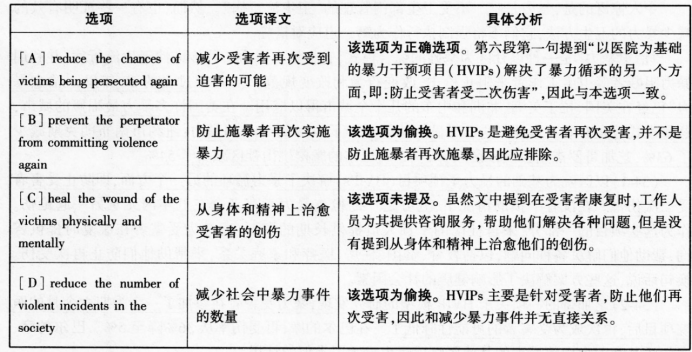
It is suggested from Paragraph 6 and Paragraph 7 that the Hips can_______.

进入在线模考

参考答案

A

答案解析

It is suggested from Paragraph 6 and Paragraph 7 that the HVIPs can_______.
第六段和第七段中建议HVIPs可以_______。
细节题。根据题干提示可定位于第六段和第七段。
 

你可能感兴趣的试题

A.Satisfaction.
B.Skepticism.
C.Objectiveness.
D.Sympathy.
2 根据下面资料,回答题
Scientists have predicted for the first time when, where and how polar bears are likely to disappear, warning that if greenhouse gas emissions stay on their current trajectory all but a few polar bear populations in the Arctic will probably be gone by 2100.
By as early as 2040, it is very likely that many polar bears will begin to experience reproductive failure, leading to local extinctions, according to a study published in Nature Climate Change.
The study examines how the bears will be affected under two different greenhouse gas emissions scenarios. The researchers found that under a business-as-usual emissions scenario, polar bears will likely probably only remain in the Queen Elizabeth Islands--the northernmost cluster in Canada's Arctic archipelago--at the end of the century. And even if greenhouse gases are moderately mitigated, it is still likely that the majority of polar bear populations in the Arctic will experience reproductive failure by 2080.
Scientists estimate that there are fewer than 26,000 polar bears left, spread out across 19 different subpopulations that range from the icescapes of Svalbard, Norway, to Hudson Bay in Canada to the Chukchi Sea between Alaska and Siberia. Polar bears are unable to find enough sustenance on land and rely on sea ice from which to hunt. They often stake out seal breathing holes in the ice, waiting hours for a blubbery meal to break the surface. But as that sea ice declines because of climate change, so, too, will the polar bears.
"It's been clear for some time that polar bears are going to suffer under climate change," said Peter Moln6r, a biologist at the University of Toronto Scarborough, and lead author of the study. "But what was not fully clear was when we would expect major declines in the survival and reproduction of polar bears that could ultimately lead to their extirpation. We didn't know whether that would happen early or later in this century. "
Polar bears draw on energy reserves built up during the winter hunting season to make it through lean summer months on land or time spent on ice in unproductive waters. Though the bears are used to fasting for months, their body condition, reproductive capacity and survival will eventually diminish if they are forced to go too long without food. In Alaska's southern Beaufort Sea population, biologists have already seen polar bear numbers drop 25-50% during low ice periods when the bears have been forced to fast for too long. And in western Hudson Bay, one of the southernmost polar bear habitats, the population has declined by roughly 30% since 1987.
To figure out when bears might reach their critical physiological limit, Moln6r and his colleagues estimated how thin and fat polar bears can be and modelled the animals' energy use to derive the threshold number of days they can fast before cub and adult survival rates decline. Then they combined those thresholds with the projected number of future sea ice-free days to determine how populations will be affected in different parts of the Arctic.
"Even if we mitigate emissions, we are still going to see some populations go extinct before the end of the century," Moln6r said. This includes the polar bears in the vulnerable, southernmost ice areas of western Hudson Bay, Davis Strait, and southern Hudson Bay. "But we would have substantially more populations persisting by the end of the century, even with reduced reproduction, compared with a business-as-usual emissions scenario. "
"It's important to highlight that these projections are probably on the conservative side," said Steven Amstrup, chief scientist for Polar Bears International and a co-author of the study. The models, he explained, may assume a better-than-reality body condition of the bears at the start of fasting periods. And the team used a cautious baseline estimate for how much energy a bear uses to maintain its body condition. "The impacts we project are likely to occur more rapidly than the paper
suggests."
Unlike other species threatened by hunting or deforestation, polar bears can only be saved if their habitat is protected, which requires tackling climate change at a global level. Previous research has shown that even if we reduce greenhouse gas emissions tomorrow, it will still take another 25 to 30 years for sea ice extent to stabilise because of all the carbon dioxide already in the atmosphere. It's important that the public understand the urgency of the issue, Amstrnp said. But a timeline for possible extirpation was also an important tool for managers in northern communities living alongside polar bears.
The passage begins with_______.
A.a research on polar bear reproduction
B.a prediction of polar bear extinction
C.a call for people to protect polar bears
D.a study of the living habits of polar bears
A.Greenhouse gas emissions are going to be mitigated in polar areas.
B.Most polar bears will be at risk of breeding failure in the future.
C.Greenhouse gas emissions will cause the extinction of all polar bears.
D.Bears in the Queen Elizabeth Islands are hardly affected by Greenhouse gas.
找试题 · 找答案 · 找资料 在线模考