单选题
题号 #6058165

The word "panacea" (Para.7) most probably means

进入在线模考

参考答案

A

答案解析

The word“panacea”(Para.7)most probably means 40.单词“panacea”(第七段)最有可能意为
A.Cure-all A.万能药
B.Solution B.解决方案
C.License C.许可证
D.prevalence D.盛行
【定位词】panacea,Para.7
词汇理解题。根据定位词定位到最后一段。该单词所在句为最后一段首句,句首的That指代上文所提到的内容,因此需要结合上文做出判断。上文指出了新冠肺炎疫情后世界的一些趋势,即数字和分析发挥更重要的作用,这些趋势的影响对每个公司来说都是不同的。数字和分析领域的领导者拥有优势,但如果其他参与者加速转型,这种优势可能很快就会消失。可见数字和分析并不是对所有公司都是优势,结合四个选项,A项“万能药”符合文意,为正确答案。
【干扰排除】根据以上分析可知,其余三个选项均与文意不符,故排除。
参考译文
新冠肺炎疫情是一场史无前例的健康危机,也是一次全球经济冲击。在疫情中,服装、时尚和奢侈品(AF&L)行业迅速行动起来以满足迫切的公共卫生需求--关闭商店,制造急需的物品以及向医疗机构和社区组织捐款。同时,AF&L公司正努力应对新冠肺炎疫情给业务带来的影响。尽管业内没有人预见到这场危机的严重程度,但一些时装公司发现,他们比其他公司更有能力应对,这主要是因为他们拥有数字技术。
4月份进行的消费者信心调查显示,在欧洲和北美洲,甚至在尚未完全封锁的国家,线下购买的意向下降了70%至80%。线上购买的意向下降了30%至40%。电子商务显然不能抵消实体商店的销量下滑。但是,由于关闭商店,这(电子商务)一直是时尚品牌的生命线,并且在恢复期间和恢复之后仍然至关重要。
数字化不仅是日益重要的销售渠道;它还可以帮助企业调整成本结构,使价值链的每一步都更好、更快、更便宜。例如,数字化可以促成新物流和销售执行选项的启用,促进创新的客户获取方式,并帮助预测和管理库存,以创建更具弹性的供应链。这一切的根本推动者将是数据,其透明度、治理和准确性从未像现在这样重要。
这一切都表明数字鸿沟的加深。甚至在危机之前,在数字和分析方面已经成熟的公司就已经超过了那些没有强大的数字和分析能力的竞争对手。新冠肺炎疫情危机只是扩大了行业领导者和落后者之间的差距。
对于有能力并愿意投资的领导人来说,疫情显然是一个加速器。正如一家领先的服装公司的高管最近宣称的那样,“我们在两个月内完成了两年的数字化转型。”
新冠肺炎疫情后世界的一些趋势,即“下一个常态”,可能会使数字和分析发挥更重要的作用。实体间的差距可能会继续存在,让消费者不太可能光顾实体店,一个零接触的经济可能会出现,将电子商务和自动化提升到一个新的水平。
这些趋势的影响对每个公司来说都是不同的,取决于它的数字化起点和战略方向。如今,数字和分析领域的领导者拥有优势,但如果其他参与者加速转型,这种优势可能很快就会消失。另一方面,落后的公司有机会在数字和分析领域“孤注一掷”,或许还可以通过较小的资本支出投资获得市场份额,而资本支出投资曾是许多品牌的一个限制因素。
也就是说,数字化不是万灵药。公司应该将投资导向商业价值最高的领域,这些领域可能不是销售领域,而是价值链的其他领域。同样重要的是,公司应该避免“镀金”,致力于最快、最小的可行性数字解决方案,以实现商业目标。最后,计划的先后顺序将在使一家公司的数字化转型尽可能实现自筹资金方面发挥重要作用。

你可能感兴趣的试题
1 根据以下材料,回答题
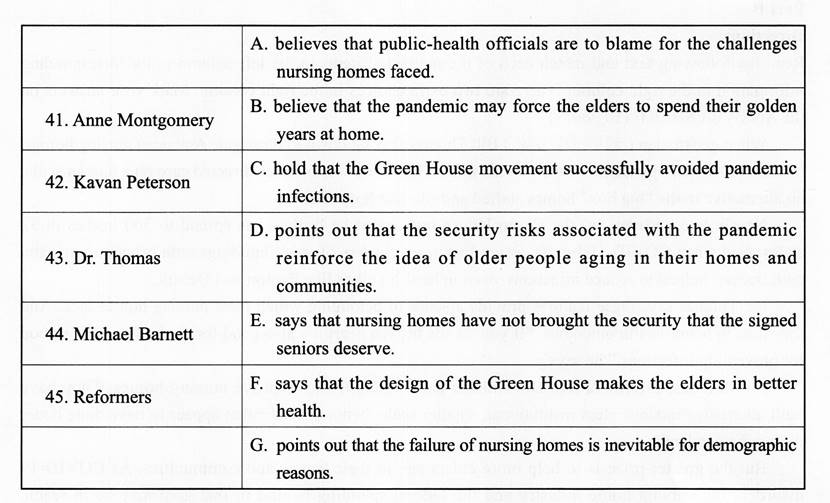
When geriatrician ( 老年医学专家 ) Bill Thomas first sat down to reimagine American nursing homes, the risk of a deadly pandemic wasn't on his mind.Hisvision was of elder-directed care on a human scale, an alternative to the"big box" homes staffed and run like hospitals.
 Nearly two decades on, the Green House movement he birthed has spread to 300 homes in 32 states.And when COVID-19 hit,its design features--clusters of small buildings with private rooms and bathrooms--helped to reduce infections, even in hard-hit cities like Boston and Detroit.
 Dr.Thomas says these features provide a sense of belonging which most nursing homes lack.And they lead to better health outcomes."If you fix the broken heart it's also good for the body, and it's good for preventing infections," he says.
 For decades, reformers like Dr.Thomas have attempted to improve nursing homes.They have built alternative models--less institutional, smaller scale, better staffed--that appear to have done better during the pandemic.
 But the greater prize is to help more elders age in their homes and communities.As COVID-19 disorders the nursing home industry and the federal spending behind it, that goal may be in reach, reformers say.
 "Most people would prefer to age in place, at home, if at all possible.The COVID epidemic might strengthen that, as people feel safer at home," says Anne Montgomery, co-director of eldercare improvement at Altarum Institute, a nonprofit health consultancy.
 The vast majority of Americans aged 65 and older currently live at home.But seniors who require support services often end up in nursing homes because they rely on Medicaid to pay for long-term care.
In recent years, alternatives to institutional care have expanded in many states,using Medicaid waivers.
More than half of Medicaid dollars are spent on home-and community--based services today.
 now COVID-19 has shined a spotlight on the often-obscured lives of around 1.5 million Americans, with more than a third of deaths coming in nursing homes.The pandemic has upended the finances and reputations of home operators.It has disrupted the profitable flow of new residents discharged from hospitals.And it has forced the industry more generally to defend its poor record on infection control and other measures of quality and safety.
 "The compact that people have made is to trade away certain freedoms and autonomy, and even respect and dignity, in return for a promise of security and safety.The COVID-19 pandemic has revealed that they [nursing homes] have not been able to fulfill that," says KavanPeterson, a Seattle-based
advocate and co-founder with Dr.Thomas of ChangingAging.
 Nursing homes have pushed back against critics, pointing to the rapid spread of COVID-19 in urban are as where hard-hit homes were located.They also say public-health officials failed to provide needed equipment and guidance.Regardless, the challenges they face are significant.
 "Nursing homes have been set up to fail.They have extremely vulnerable populations," says
MichaelBarnett, assistant professor of health policy and management at the Harvard T.H.ChanSchool
of Public Health."They have workers who are underpaid and are largely immigrants and minorities who
live in communities that are the worst affected."

41题答案是
A.A
B.B
C.C
D.D
E.E
F.F
G.G
A.A
B.B
C.C
D.D
E.E
F.F
G.G
A.A
B.B
C.C
D.D
E.E
F.F
G.G
找试题 · 找答案 · 找资料 在线模考