根据以下材料,回答题
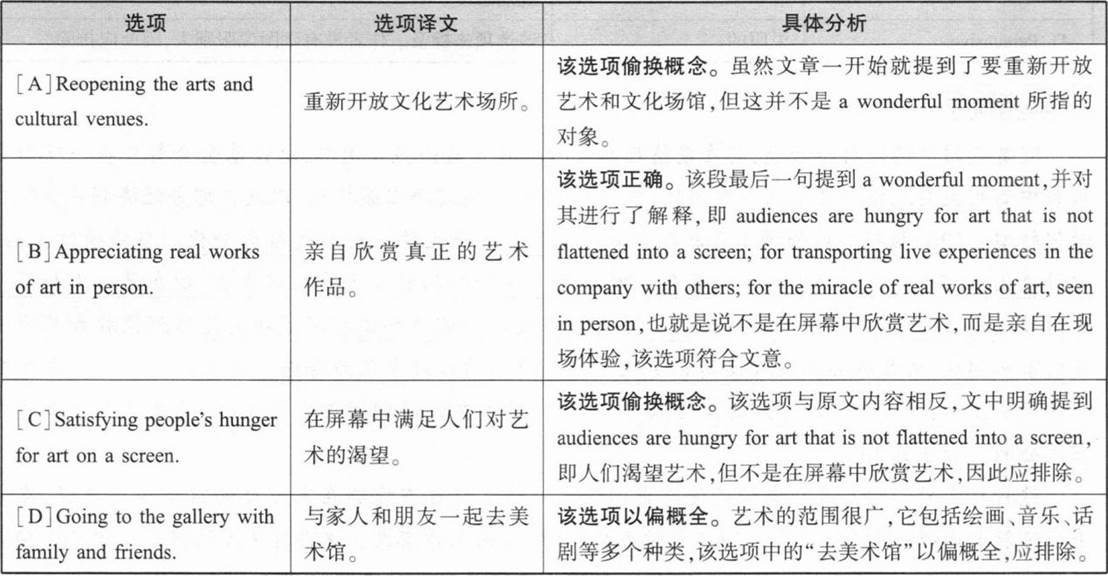
On 17 May, arts and cultural venues may reopen; indeed commercial galleries, by virtue of their status asshops, were able to open on 12 April.The public will be able to visit museums and art galleries, and booktickets for concerts and theatres.And they may do so with confidence: venues have become adept at puttingsafety measures in place and managing numbers to limit the risk posed by Covid-19.It will be a wonderfulmoment: audiences are hungry for art that is not flattened into a screen; for transporting live experiences inthe company with others; for the miracle of real works of art, seen in person.
But these undoubted pleasures will mask the fact that the cultural sector of the UK economy--a growtharea before the pandemic--is in trouble.This can easily be glimpsed in the latest figures released last week bythe Office for National Statistics.These show that job vacancies in arts and entertainment, in the periodJanuary to March 2021, were down 79% on the equivalent period in 2020.It is by far the worst hit part of theeconomy, well ahead of even hospitality at 70%, and soaring above the average across all industries of 23%.
The government has rightly apportioned emergency funding to arts and heritage institutions--money thatwas welcome, arresting the plunge of many of them into bankruptcy.But it failed to support individualcreative workers, most of whom are freelance, and many of whom are ineligible for government support.Thegovernment has also failed, despite repeated pleas, to help arts organisations with a scheme to supportinsurance for them--as it has rightly done for the television and film industries.This has led to a bizarresituation, especially for summer festivals.Events are being mothballed, despite being perfectly entitled to goahead, because of the risk that government guidance could change and force their cancellation at the lastmoment, leaving them exposed to financial ruin.Industry figures warn that the current trickle of suchcancellations could soon become a flood.
The loss of much-longed-for summer festivals is sad for audiences, but catastrophic for cultural jobs.Forevery festival that is not going ahead there will be artists and technicians no longer working--not to mentionfront-of-house staff, security guards, cleaners and bar staff.Amid all this, the workers affected have of courseadapted--driving vans, stacking shelves, taking teaching work.
As the veteran folk singer Peggy Seeger has recently pointed out, that's no trivial matter: art is a dailypractice and discipline, not something that can be dropped and picked up at will.According to those on theright, all this is absolutely fine: it's simply market forces at work.Some even talk of a welcome winnowingdown--if the pandemic sees the weakest go to the wall, then so be it.This view is careless, and despicable.You can judge a society by the respect accorded to its artists, and there's something going badly wrong in acountry that leaves someone who's trained half a lifetime to achieve a pitch of miraculous skill unable to use it.
What does "a wonderful moment" (Para.1) refer to?
参考答案
B
答案解析
文章来源:The Guardian,Apr.26th,2021
原文标题:The Guardian View on Reopening the Arts:Behind the Scenes,All Is Not well
What does“a wonderful moment”(Para.1)refer to?
“a wonderful moment”(第一段)指的是什么?
细节题。根据题干提示可定位于第一段。
原文标题:The Guardian View on Reopening the Arts:Behind the Scenes,All Is Not well
What does“a wonderful moment”(Para.1)refer to?
“a wonderful moment”(第一段)指的是什么?
细节题。根据题干提示可定位于第一段。
你可能感兴趣的试题
A.people enjoyed great pleasure from visiting the art venues
B.the British cultural economy ran into difficulties during the pandemic
C.the British economy has been hit hard by the pandemic
D.all industries have been affected by the outbreak of Covid-19
A.Government provided funding for both collective and individual art workers.
B.Government designed plan to help art organizations develop and flourish.
C.Many ineligible art workers also got financial support from the government.
D.Flexibel government guidance caused financial loss to art organizations.
A.joyous
B.disastrous
C.fortunate
D.relieved