简答题
题号 #6559920

Directions:
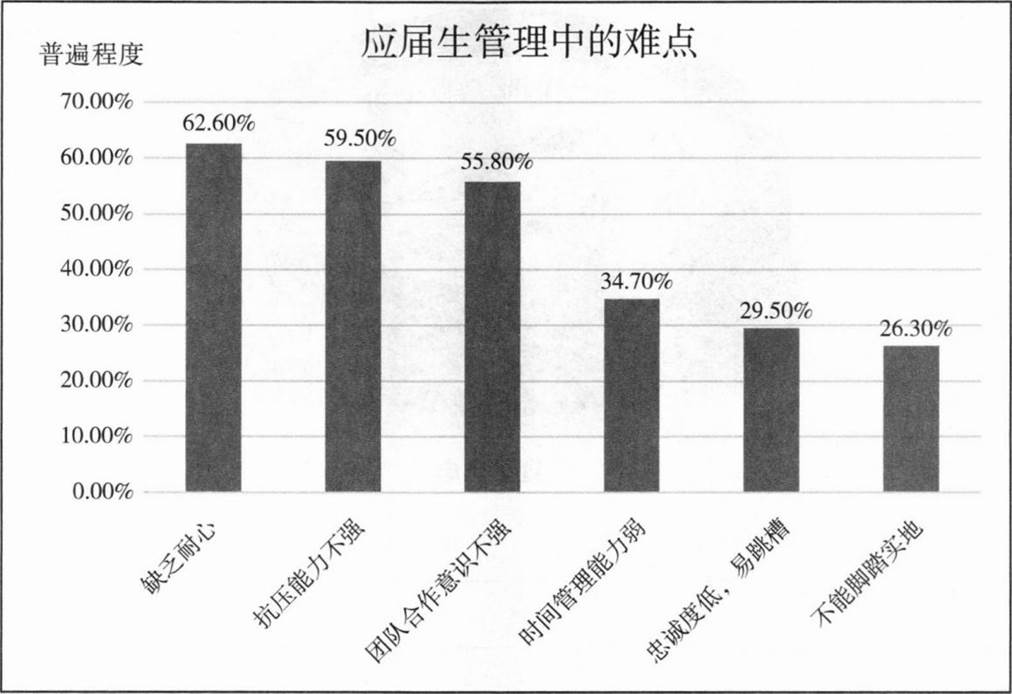
  Write an essay based on the chart below.In your writing, you should
     1 ) interpret the chart, and
     2) give your comments.
  You should write about 150 words on the ANSWER SHEET.( 15 points)
进入在线模考

参考答案

暂无

答案解析

参考范文:
 The bar chart shows the difficulties in managing newly graduated employees. As can be seen, lack ofpatience among graduates ranks the number one headache for employers (62.6%), followed by low stressendurance (59. 5%). Moreover, over half of graduates show inadequate collaborative awareness.Graduates' other traits that keep disappointing managers include unsatisfactory time management, deficientloyalty and lack of down-to-earth attitude.
 Having incompetent and irresponsible graduates as employees is troublesome for companymanagement, and there are several possible strategies for employers to tackle it. Firstly, companies couldadopt a trial period before official hiring decisions are made. By assessing candidates' performance duringthis period, employers are able to sift out the unqualified. Secondly, companies could establish cooperativetraining programs with colleges, which give employers chances to identify potential employees who are bothresponsible and capable. Finally, effective incentive mechanisms should be built to ensure that staffmembers are motivated to improve their work performance. For us college students, this chart also delivers informative lessons.
For example, we need to tryputting ourselves in employers' shoes, seeking to understand their difficulties in managing a company.
参考译文:
该柱状图显示了管理应届生员工的困难。可以看出,大学毕业生缺乏耐心是雇主最头疼的问题(62.6%),其次是抗压能力不强(59.5%)。此外,超过一半的毕业生缺乏合作意识。毕业生其他让管理者失望的特征包括时间管理能力弱、忠诚度低以及不能脚踏实地。
雇用能力不足和不负责任的毕业生会给公司管理造成麻烦,雇主可以采取几个策略来解决这一问题。首先,公司可以在做出正式聘用决定之前采用试用期。通过评估候选人在此期间的表现,雇主能够筛去那些不合格的人。其次.公司可以与高校建立合作培训计划,这可以让公司有机会发现那些既负责任又有能力的潜在员工。最后,应建立有效的激励机制,确保员工有动力改善自己的工作表现。对于我们大学生来说,这个图表也提供了有益的教训。比如,我们需要尝试站在雇主的立场上,试图理解他们在管理公司时的困难。

你可能感兴趣的试题
2 根据以下材料,回答题
How do early experiences shape development? A new paper by Dr.Mackey and hercolleagues looks at evidence from both human and animal studies.They 1 that poverty, stressand adverse experiences seem to make children's brains grow up too quickly.
   Why would stress and adversity make us grow up faster and a rich, varied, nurturingenvironment make us grow up more slowly? One influential recent idea 2 from the biologicalconcept of "life history." A long, slow life history 3 with a big, smart brain.The smartestmammals and birds, like chimps and crows, also have a particularly long childhood, and adults puta lot of work into 4 the young.We humans are particularly 5 , with an especially longchildhood and large caregiving 6   .
  Different species have different life histories, but different individual animals also maydevelop different life histories.Some will 7 more quickly, while others stay young for longer.Early experiences can 8 these individual life histories. 9 , what happens when you'reyoung tells you about the sort of world you will face when you get older.
   A "live fast, die young" life history makes more evolutionary 10 when resources arescarce and life is 11 harsh. 12 learning may not do much good in that case, so it's betterfor young creatures to quickly zero in on a few effective survival techniques.In a rich, supportive,varied world, 13 , there is 14 to learn and time and resources to learn it, so keeping anopen mind and flexible brain is more 15 .Early adverse experiences may be cues that the life tocome will be harsh and short, while a nurturing preschool 16 a richer set of possibilities.
   Loving your children and giving them space to 17 is more important than crafting aparticular curriculum.A longer, slower childhood may be better, at least if you 18 that theadult environment will also be rich and varied.But as the research on adverse experiences shows,far too many children and parents don't have the resources they need to 19 that sort ofchildhood.Whether through child tax credits, parental leave or high-quality preschool, supportingyoung children is the best way to ensure a new generation of 20 adults.
第1题答案是(  )
A.defend
A.defend
B.conclude
B.conclude
C.deny
C.deny
D.doubt
D.doubt
A.takes off
A.takes off
B.breaks away
B.breaks away
C.takes over
C.takes over
D.stands out
D.stands out
找试题 · 找答案 · 找资料 在线模考