A.Because they are poor.
B.Because they are in trouble with the law.
C.Because conditions favored the old life are gone forever.
D.Because they don't want to adopt the white man's ways.
参考答案C
解析:C
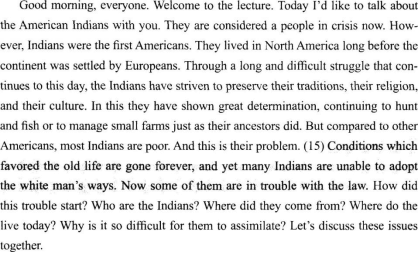
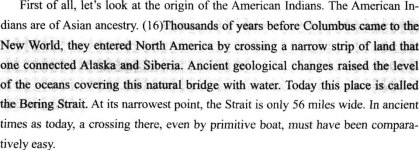
The migrants entered a new world in which there were no people at all. But there were forests where many animals to be hunt, and nuts, roots, and berries to be gathered. Living comfortably on this food supply, the newcomers spread out. Some moved south into Central and South America. Others traveled east of the At- lantic Ocean. These migrations were gradual, probably taking thousands of years. Eventually, the people who became the American Indians had spread across North America.
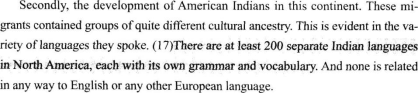
The regions of North America where the newcomers lived varied greatly in climate and food supply. In the plains and eastern forests where resources were plentiful, the Indians hunted and fished. In the dry Southwest, they farmed. These regional differences explain the richness and variety of Indian culture: dissimilar economics produced quite different systems of society.
For instance, many Indians of the Southwest, such as the Hopi and the Zuni, were village Indians. They built mud brick houses and developed agriculture. Many of them learned to irrigate; others became expert dry farmer. They grew beans, corn, and other vegetables. They made baskets, raised and wove cotton, and made beauti- ful pottery.
The migrants entered a new world in which there were no people at all. But there were forests where many animals to be hunt, and nuts, roots, and berries to be gathered. Living comfortably on this food supply, the newcomers spread out. Some moved south into Central and South America. Others traveled east of the At- lantic Ocean. These migrations were gradual, probably taking thousands of years. Eventually, the people who became the American Indians had spread across North America.
The regions of North America where the newcomers lived varied greatly in climate and food supply. In the plains and eastern forests where resources were plentiful, the Indians hunted and fished. In the dry Southwest, they farmed. These regional differences explain the richness and variety of Indian culture: dissimilar economics produced quite different systems of society.
For instance, many Indians of the Southwest, such as the Hopi and the Zuni, were village Indians. They built mud brick houses and developed agriculture. Many of them learned to irrigate; others became expert dry farmer. They grew beans, corn, and other vegetables. They made baskets, raised and wove cotton, and made beauti- ful pottery.
你可能喜欢
A.narrow strip of land.
B.A manufacture bridge.
C.A narrow strait.
D.An island.
A.More than 300.
B.Less than 300.
C.Less than 200.
D.At least 200.
A.Education and national security.
B.A new report by the Council on Foreign Relations.
C.The impact of poor education.
D.Social cohesion and American dream.