单选题
题号 #6058164

This crisis is an accelerator for leading companies because

进入在线模考

参考答案

D

答案解析

This crisis is an accelerator for leading companies because。39.这场危机是领先的公司的加速器,因为
A.it deepened the digital divide A.它加深了数字鸿沟
B.it helped them defeat the competitors B.它帮助它们打败对手
C.it attracted investmentin directly C.它间接地吸引了投资
D.it quickened their diNtal transformation D.它加快了它们的数字化转型
【定位词】an accelerator,leading companies
事实细节题。根据定位词定位到第四段。倒数第二旬指出,对于有能力并愿意投资的领导人来说,疫情显然是一个加速器。最后一句表明原因,正如一家领先的服装公司的高管最近宣称的那样,“我们在两个月内完成了两年的数字化转型。”即疫情加速了一些公司的数字化转型,D项符合文意,为正确答案。
【干扰排除】根据以上分析,其余三个选项与该段最后一句所述内容均不相符,故均排除。

你可能感兴趣的试题
A.cure-all
B.solution
C.license
D.prevalence
2 根据以下材料,回答题
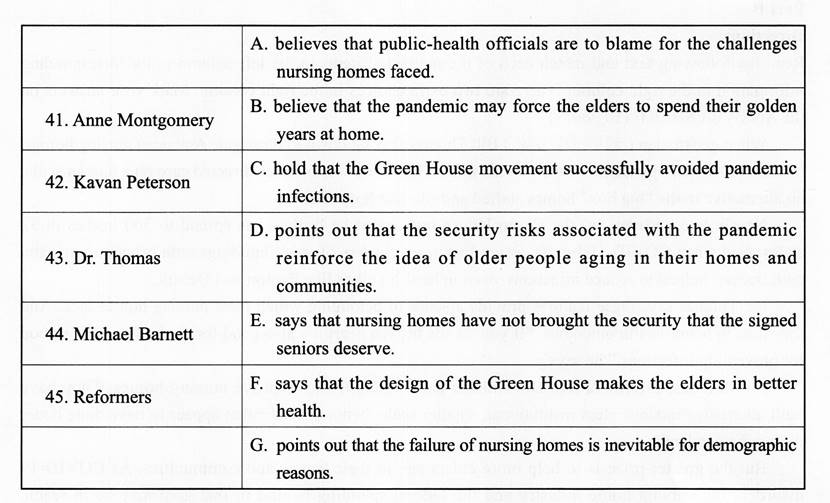
When geriatrician ( 老年医学专家 ) Bill Thomas first sat down to reimagine American nursing homes, the risk of a deadly pandemic wasn't on his mind.Hisvision was of elder-directed care on a human scale, an alternative to the"big box" homes staffed and run like hospitals.
 Nearly two decades on, the Green House movement he birthed has spread to 300 homes in 32 states.And when COVID-19 hit,its design features--clusters of small buildings with private rooms and bathrooms--helped to reduce infections, even in hard-hit cities like Boston and Detroit.
 Dr.Thomas says these features provide a sense of belonging which most nursing homes lack.And they lead to better health outcomes."If you fix the broken heart it's also good for the body, and it's good for preventing infections," he says.
 For decades, reformers like Dr.Thomas have attempted to improve nursing homes.They have built alternative models--less institutional, smaller scale, better staffed--that appear to have done better during the pandemic.
 But the greater prize is to help more elders age in their homes and communities.As COVID-19 disorders the nursing home industry and the federal spending behind it, that goal may be in reach, reformers say.
 "Most people would prefer to age in place, at home, if at all possible.The COVID epidemic might strengthen that, as people feel safer at home," says Anne Montgomery, co-director of eldercare improvement at Altarum Institute, a nonprofit health consultancy.
 The vast majority of Americans aged 65 and older currently live at home.But seniors who require support services often end up in nursing homes because they rely on Medicaid to pay for long-term care.
In recent years, alternatives to institutional care have expanded in many states,using Medicaid waivers.
More than half of Medicaid dollars are spent on home-and community--based services today.
 now COVID-19 has shined a spotlight on the often-obscured lives of around 1.5 million Americans, with more than a third of deaths coming in nursing homes.The pandemic has upended the finances and reputations of home operators.It has disrupted the profitable flow of new residents discharged from hospitals.And it has forced the industry more generally to defend its poor record on infection control and other measures of quality and safety.
 "The compact that people have made is to trade away certain freedoms and autonomy, and even respect and dignity, in return for a promise of security and safety.The COVID-19 pandemic has revealed that they [nursing homes] have not been able to fulfill that," says KavanPeterson, a Seattle-based
advocate and co-founder with Dr.Thomas of ChangingAging.
 Nursing homes have pushed back against critics, pointing to the rapid spread of COVID-19 in urban are as where hard-hit homes were located.They also say public-health officials failed to provide needed equipment and guidance.Regardless, the challenges they face are significant.
 "Nursing homes have been set up to fail.They have extremely vulnerable populations," says
MichaelBarnett, assistant professor of health policy and management at the Harvard T.H.ChanSchool
of Public Health."They have workers who are underpaid and are largely immigrants and minorities who
live in communities that are the worst affected."

41题答案是
A.A
B.B
C.C
D.D
E.E
F.F
G.G
A.A
B.B
C.C
D.D
E.E
F.F
G.G
找试题 · 找答案 · 找资料 在线模考